What 15 Years of Global Career Research Tells Us — And Why Nepal Is Missing From the Picture
Based on 239 peer-reviewed studies · 2010–2025 · PRISMA-filtered · Lens.org export
Studies Reviewed (2010–2025)
Peak Publications in 2022
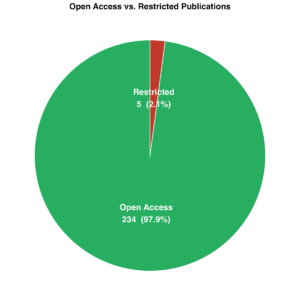
Open Access Research
Studies Covering Nepal / South Asia
The world is paying more attention to careers — fast
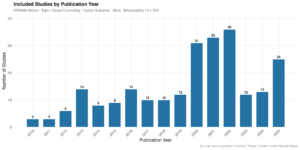
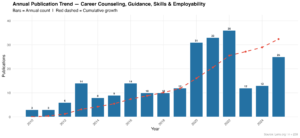
Career counseling and employability have quietly become some of the fastest-growing areas of academic research. A bibliometric review of 239 peer-reviewed studies published between 2010 and 2025 reveals a striking upward trend: from just three publications in 2010, the field surged to a peak of 36 studies in 2022 — more than ten times the starting volume in just over a decade.
The message is clear: the world’s researchers have concluded that how we guide people toward meaningful work matters enormously. The COVID-19 pandemic appears to have accelerated this conversation, with 2020 and 2021 marking the sharpest inflections in the data.
Key takeaway: Publication volume grew 10× from 2010 to 2022, with the steepest growth occurring after 2019, signaling that career guidance is now treated as a serious academic and policy priority globally.
What the research is actually about
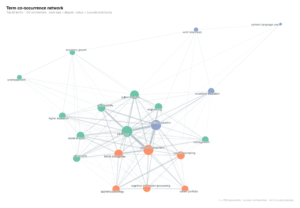
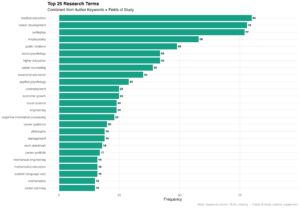
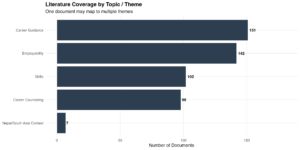
The literature clusters around five themes. Career Guidance led with 151 documents, followed closely by Employability (142), Skills (102), and Career Counseling (98). Taken together, these themes reflect a global consensus: young people need structured support — not just job listings — to navigate modern labor markets.
The co-occurrence of terms such as pedagogy, social psychology, and cognitive information processing alongside career development reveals something important: effective career guidance is not just about job matching. It is fundamentally about psychology, learning, and identity development.
Who is leading the conversation
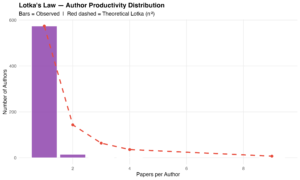
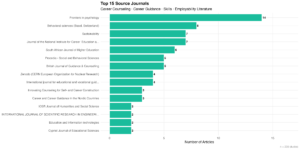
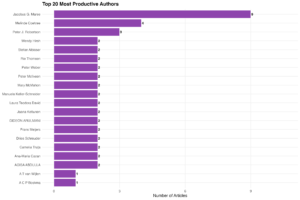
Frontiers in Psychology was the single most prolific source journal with 14 articles, followed by Behavioral Sciences (8) and Sustainability (7). The most productive author globally is Jacobus G. Maree, with nine publications — nearly double the next most prolific researcher.
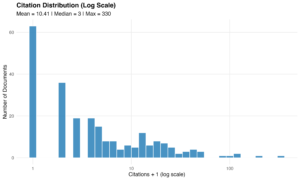
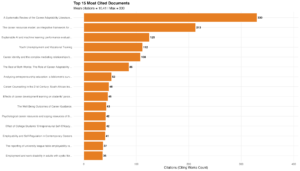
The most cited single work is a systematic review of Career Adaptability Literature, with 330 citations, suggesting that adaptability — not just skill — is the organizing concept shaping the field.
Career adaptability: The capacity to anticipate and manage occupational transitions has emerged as the most influential concept in the field, as evidenced by 330 citations for the leading systematic review. This has direct implications for the design of career programs in Nepal.
The geography of career knowledge — and the gap Nepal must fill
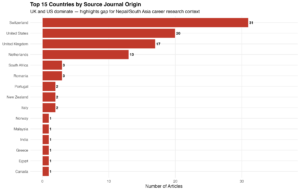
Perhaps the most telling finding in the entire dataset was geographic. Switzerland (31 articles), the United States (20), the United Kingdom (17), and the Netherlands (13) dominate the source journals. South Asia, home to over a billion young people, contributes almost nothing to this global body of knowledge.
Only seven of the 239 studies addressed the Nepal/South Asia context. This is 2.9% of the literature for a region containing roughly 25% of the world’s youth population. The frameworks, tools, and recommendations that shape global career guidance policy are almost entirely built on data from Western, high-income countries.
This is not only an academic problem. When career counselors in Nepal use Western assessment tools or follow guidance frameworks designed for Swiss or American labor markets, they are working with maps that do not correspond to the terrain. Nepal’s unique context — a remittance-driven economy, brain drain, informal employment, vocational stigma, and the underrepresentation of women in formal careers — demands its own research base.
Open access and citation landscape
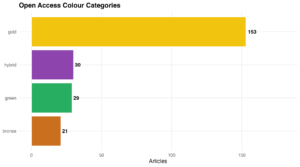
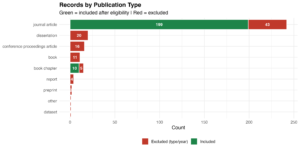
A remarkable 97.9% of the 239 studies are openly accessible, meaning there is virtually no paywall barrier for practitioners in Nepal to engage with the world’s best career research. Gold open access dominated with 153 articles, followed by hybrid (30), green (29), and bronze (21).
The citation distribution is highly skewed: the mean is 10.41, but the median is just 3, meaning a small number of landmark papers drive the majority of academic influence. This is typical of maturing research fields and suggests significant room for growth.
What this means for career practitioners in Nepal
- Adaptability over planning: The research consensus points toward building career adaptability — resilience, curiosity, and flexibility — rather than rigid five-year plans. Nepal’s unpredictable job market makes this particularly relevant.
- Psychology belongs in career guidance: The strong presence of social psychology in the literature signals that career counselors should be trained in motivational psychology, not just occupational information.
- Employability is teachable: With 142 studies on employability, the research clearly shows that the skills gap is addressable through structured programs, not just left to chance or family connections.
- Open access creates opportunities: With 97.9% of studies freely available, Nepali researchers and practitioners have no barriers to accessing global knowledge. The gap is not access; it is local application.
- We need to publish: Nepal’s career practitioners have real-world insights that the global field does not have. Contributing to peer-reviewed journals would benefit both local and global discussions.
The world has quietly built a science of career guidance. Nepal has every tool it needs to benefit from it — and every reason to start contributing to it.
References
Collins, M. E., & Spindle‐Jackson, A. (2024). “Time has come again” for career pathways: Workforce development for youth in the US. Poverty & Public Policy, 16(2), 182–200. https://doi.org/10.1002/pop4.399
Hartung, P. J., Walsh, W. B., & Savickas, M. L. (2015). APA handbook of career intervention, Volume 2: Applications. American Psychological Association. https://doi.org/10.1037/14439-000
Ineza, P., & Ndagijimana, J. B. (2025). Impact of providing career guidance on students’ academic performance. African Quarterly Social Science Review, 2(3), 188–207. https://doi.org/10.51867/aqssr.2.3.17
Mahat, D., & Aithal, P. S. (2022). Socio-culture and Women Career Development. International Journal of Management, Technology, and Social Sciences, 241–249. https://doi.org/10.47992/ijmts.2581.6012.0218
Osborn, D. S., Sides, R. D., & Brown, C. A. (2020). Comparing Career Development Outcomes Among Undergraduate Students. The Career Development Quarterly, 68(1), 32–47. https://doi.org/10.1002/cdq.12211
Suwidagdho, D., & Dewi, S. P. (2020). The challenge of career guidance and counseling during the covid-19 pandemic. KONSELI: Jurnal Bimbingan Dan Konseling, 7(2), 117–122. https://doi.org/10.24042/kons.v7i2.7502
Career Counseling and Coaching